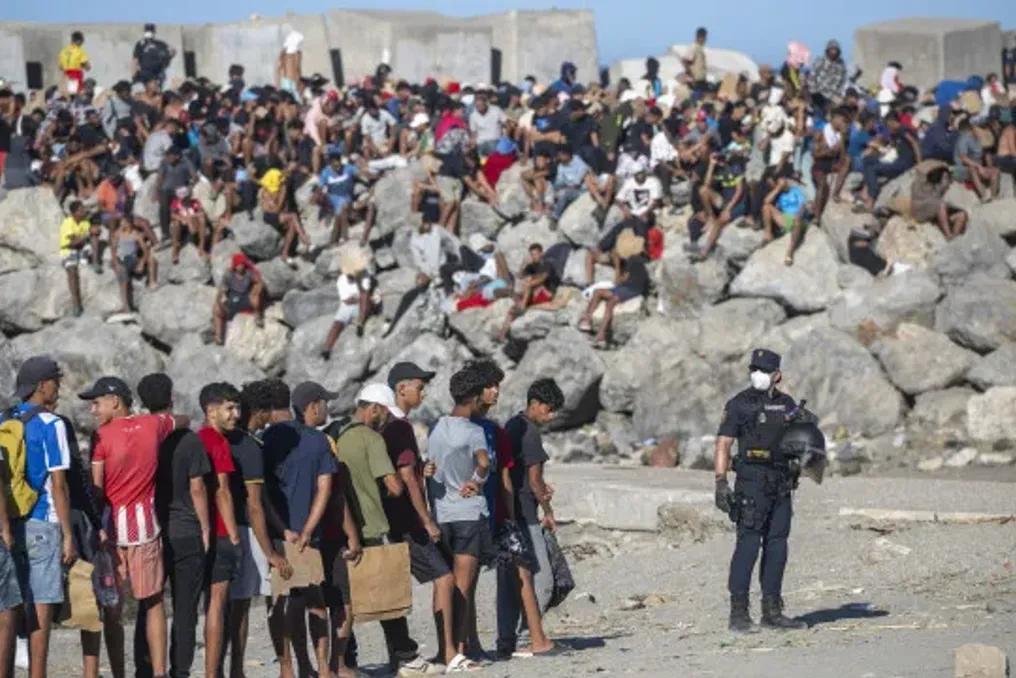
According to updated data provided today by the Spanish government, about 3,500 migrants continue to spend time on the streets and beaches of Ceuta. These individuals are in temporary accommodation sites where they are identified and registered to begin repatriation procedures or asylum applications.
The total number of people in such conditions is around 6,000 adults and nearly 2,400 minors. The Minister of Territorial Policy, Ángel Víctor Torres, who coordinates the government's response to this crisis, calculated that between 3,000 and 3,500 people, including hundreds of children, remain on the streets and beaches of Ceuta.
The Minister for Childhood, Sira Rego, specified that, according to her estimates, the number of unaccompanied minors still on the streets ranges from 500 to 700.
Ángel Víctor Torres stated that the government expects to provide temporary housing for all these people within 'a very short number of weeks' and that decisions regarding return to Morocco 'will begin to be issued.'
Regarding adults, the Spanish government has repeatedly stated that most of them will be repatriated as they do not have the right to asylum. However, Minister Sira Rego noted that most minors, to whom other protection and guarantee laws apply, do not wish to return to Morocco and will 'remain' in Spain.
Sira Rego called on regional governments to promptly arrange the placement of minors in reception centers in other parts of Spain, as required by law.
Interior Minister Fernando Grande-Marlaska stated at a press conference in Ceuta that the analysis of repatriation processes takes up to six weeks after migrant registration. Grande-Marlaska emphasized that national laws and rules of the European Pact on Migration and Asylum apply to these individuals, which mandate temporary accommodation, registration, and the opening of processes for possible international protection.
He also reiterated that Spain will request the EU to accelerate these procedures in cases of crises similar to the one in Ceuta. The Interior Minister added that accelerating and carrying out repatriation processes is only possible with the cooperation of the migrants' countries of origin.
It is reported that at least 72,000 people entered Ceuta illegally, the Spanish city in North Africa, on July 30 and 31.
Spanish Prime Minister, socialist Pedro Sánchez, expressed hope that the situation in Ceuta will stabilize by the end of the year. He insists that only temporary accommodation and registration of all people allow for repatriation, as prescribed by national and European laws.
The right-wing opposition in Spain demands the immediate repatriation of all persons who illegally entered Ceuta in July. The executive branch is also criticized by this opposition and other parties for its slow reaction to the Ceuta crisis, which has been marked by mutual accusations between the central government, led by socialists, and the local government from the People's Party (PP, right).
The Spanish government complains about obstacles created by the city's executive branch in providing accommodation places for migrants or in transferring unaccompanied minors to other regions of Spain, accusing the PP of trying to 'make the crisis chronic.' The PP and the local government deny these accusations, asserting that Sánchez's executive branch refuses to take responsibility, and insist on the immediate return of all persons to Morocco, emphasizing that this is not a migration crisis but an issue of defense and security, as the events of July were an 'invasion,' an attack on the border and the integrity of Spanish territory.