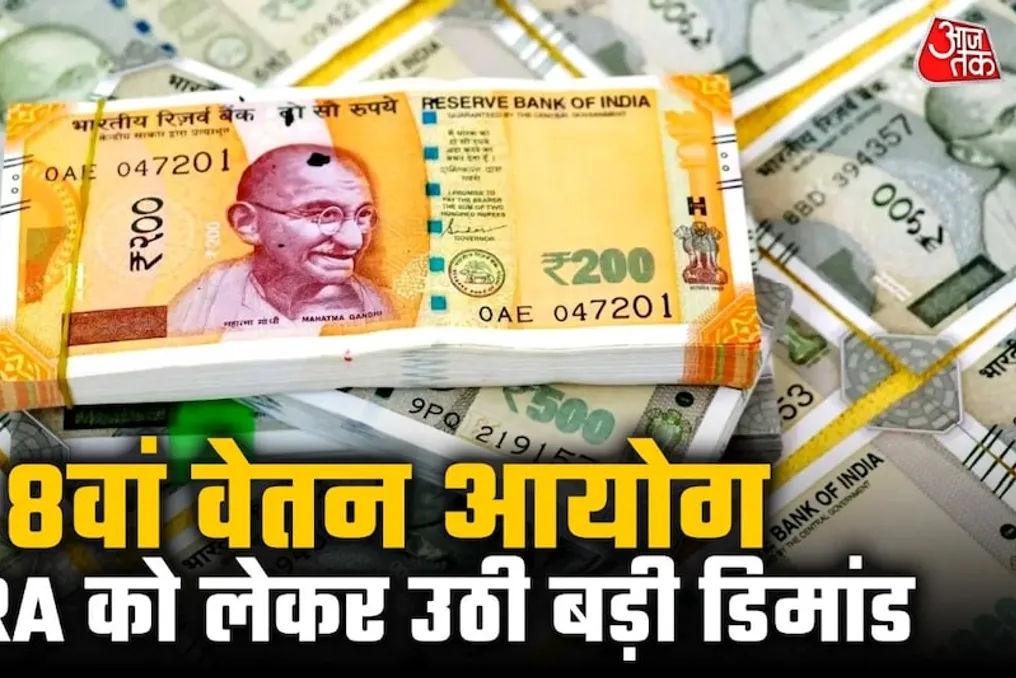
How will the salary of central employees change with an increase in housing allowance within the framework of the 8th Pay Commission?
Read more
Aaj Tak
www.aajtak.in

How will the salary of central employees change with an increase in housing allowance within the framework of the 8th Pay Commission?

Central employees are closely monitoring the work of the 8th Pay Commission as various aspects are being discussed, including basic salary, fixation coefficient, and pension provision. Simultaneously, there is an increasing need to raise the House Rent Allowance (HRA) due to the constant rise in rental prices and cost of living in cities.

Trade unions insist on the necessity of adjusting current HRA rates to account for current inflation and rental prices. If a decision is made to increase HRA in conjunction with applying a fixation coefficient that increases the basic rate, the share of HRA in the salary of central employees could significantly rise. For instance, for a Level 10 employee, the HRA could potentially exceed ₹57,671 per month, based on assumptions of a 2.57 fixation coefficient and a 40% HRA rate. However, it should be noted that this is not yet a final increase, as neither the Pay Commission nor the government has made any decisions on this matter.

The House Rent Allowance is provided to central employees to cover accommodation expenses in the city where they are posted and is part of their income. The amount of this payment depends on the employee's basic rate and the category of the city where they work. In recent years, rental costs and other living expenses in major cities have increased substantially. Therefore, trade unions argue that the existing HRA rates must be revised in line with current costs. Currently, central employees receive 30%, 20%, and 10% respectively in cities of categories X, Y, and Z, which was established after the revision in January 2024. Now, before the 8th Pay Commission, trade unions have put forward demands to increase these rates.

The demands of various trade unions are not uniform, but most proposals exceed the current HRA rates. The National Confederation of Joint Consultative Mechanism (NC-JCM), representing the interests of central government employees and pensioners in India, has requested HRA rates of 40%, 35%, and 30% for cities of categories X, Y, and Z. A similar demand was put forward by the All India Defence Employees Federation (AIDEF). Furthermore, the organization demanded the extension of such benefits, like HRA, to pensioners. On the other hand, the Indian Railways Technical Supervisors Association (IRTSA) proposed setting four different HRA rates: 40%, 30%, 20%, and 10%. Thus, the focus of the trade unions is not only on increasing the basic rate but also on increasing the HRA rate in line with current expenses.

It is easiest to understand the house rent allowance by viewing it as a percentage of the basic rate. If an employee's basic salary is ₹50,000 and HRA is 30%, the HRA amount will be ₹15,000. If the HRA rate rises to 40%, the HRA will increase to ₹20,000, giving the employee an additional monthly income of ₹5,000 just from the change in the HRA rate. However, if the 8th Pay Commission increases the basic rate through the fixation coefficient, the effect will be much more significant, as HRA will be calculated based on the new basic salary.

According to the 7th Pay Commission, the initial basic rate for a Level 1 employee is ₹18,000. If the employee is in a Category X city, at the current HRA rate of 30%, they receive: ₹18,000 multiplied by 30% = ₹5,400 HRA. Suppose a fixation coefficient of 2.1 is applied in the 8th Pay Commission; then the new basic rate could be: ₹18,000 multiplied by 2.1 = ₹37,800. If the HRA rate remains at 30%, the HRA will be: ₹37,800 multiplied by 30% = ₹11,340, which means an increase in HRA of ₹5,940 compared to the previous ₹5,400. If, in this example, the HRA rate rises to 35%, the calculation would be: ₹37,800 multiplied by 35% = ₹13,230, ensuring an increase in HRA of ₹7,830 relative to the original ₹5,400. It is important to remember that these are only hypothetical calculations, and the final decision on the basic rate and HRA will only be taken after the recommendations of the 8th Pay Commission and approval by the government.

Let's consider the situation for Level 10 central employees. The initial basic rate according to the 7th Pay Commission is ₹56,100. At current HRA rates, the situation is as follows: in Category X — 30% of ₹56,100, which equals ₹16,830; in Category Y — 20% of ₹56,100, amounting to ₹11,220; and in Category Z — 10% of ₹56,100, which equals ₹5,610. This demonstrates that even at the same level, the HRA amount varies depending on the city category. If the 8th Pay Commission leads to an increase in the basic rate through the fixation coefficient and simultaneously raises the HRA rate, the difference in amounts can become very substantial.

Applying a fixation coefficient of 2.1 to the Level 10 basic rate (₹56,100) will lead to a potential new basic rate: ₹56,100 multiplied by 2.1 = ₹1,17,810. If the HRA rate is set at 40% in this scenario, the resulting HRA will be: ₹1,17,810 multiplied by 40% = ₹47,124. Thus, in this forecast, the HRA could reach approximately ₹47,124 per month. If the HRA rate is 35%, the calculation will be: ₹1,17,810 multiplied by 35% = ₹41,234, and at a 30% rate — approximately ₹35,343.

Similar stories

Eighth Pay Commission Council: Salary Hike of ₹51,000 Conditional on Government Acceptance of Demands
Read more
www.aajtak.in

Eighth Pay Commission Council: Salary Hike of ₹51,000 Conditional on Government Acceptance of Demands

The meetings of the Eighth Pay Commission (8th Pay Commission) are ongoing. Following sessions held in Chennai-Puducherry, meetings will take place in Chandigarh from September 16 to 18. Among the most significant demands voiced in Chennai is raising the Fitment Factor to the level of 3.83.

The demand for increasing the Fitment Factor is central to discussions with unions of central government employees and other stakeholders. If the government under N. Modi accepts this demand, over 50 million central employees will receive a substantial salary increase. Upon acceptance of this requirement, the minimum salary for Level-1 employees will increase by approximately ₹51,000, positively impacting employees across various pay scales. Furthermore, this will benefit around 69 million pensioners.

This demand was put forward in Chennai by the All India Union of Pensioners. However, it is not the only union insisting on a high fitment factor; the National Council of Joint Consultative Mechanisms (NC-JCM), the All India Defence Employees Federation (AIDEF), and the All India Union of New Pension System Employees have also proposed a fitment factor of 3.833. If this demand is met, there will be a significant rise in salaries for all central employees from Level-1 to Level-10.

The minimum basic salary for Level-1 will reach approximately ₹69,000. In addition to the fitment factor, demands are being made regarding pay matrices, Dearness Allowance (DA), House Rent Allowance (HRA), and other benefits and allowances. Nevertheless, the final official decision is yet to be made.

Since the final report of the Eighth Pay Commission Committee, chaired by Justice Ranjana Prakash Desai, is planned to be submitted in May-June 2027, no decision has been reached yet.

The fitment factor that is being demanded to be increased is an indicator used by the Pay Commission to convert the previously adjusted basic salary of an employee or retired pensioner into a new adjusted basic salary. The calculation is done using the formula: (current basic salary x fitment factor = new basic salary). Under the Seventh Pay Commission, the fitment factor was 2.57, which led to an increase in the minimum basic salary from ₹7,000 to ₹18,000. Now, the Eighth Pay Commission demands it be set at 3.833, which is 1.26 higher.

Regarding the fitment factor formula, it is 'new basic salary: current basic salary x FF'. Currently, the fitment factor for central employees is 2.57, according to the Seventh Pay Commission, which caused the minimum basic salary to rise from ₹7,000 to ₹18,000. If it is raised to 3.83, the minimum basic rate will be ₹68,940 (₹18,000 x 3.83). This means a direct increase in the minimum salary for employees of ₹50,940.

If we consider the salary hike for Levels 2 to 10, the basic salary of a Level-2 employee of ₹19,900 will rise to ₹76,217, and for Level-3—from ₹21,700 to ₹83,111. Further, the minimum salary for a Level-4 employee will increase from ₹25,500 to ₹97,665, for Level-5—from ₹29,200 to ₹1,11,836, for Level-6—from ₹35,400 to ₹1,35,582, and for a Level-10 employee—from ₹56,100 to ₹1,14,863.

Thanks to this increase in the fitment factor, in addition to 50.14 million government employees receiving a salary hike, about 69 million pensioners will also see an increase in their pension. At a factor of 3.833, if the government approves it, a monthly pension of ₹25,000 will rise to ₹95,750.

Third Plan: Third Pension Fund, Fitment Coefficient of 3.8, and a 6% Increase
Read more
www.aajtak.in

Third Plan: Third Pension Fund, Fitment Coefficient of 3.8, and a 6% Increase

Discussions among central government employees and pensioners have intensified in connection with the eighth pension commission, particularly regarding salary and pension calculations. Pensioners have put forward several demands within the framework of the eighth pension commission, the adoption of which would lead to a significant increase in pension amounts.

The Staff-Side National Conference (NC-JCM) demanded that the fitment coefficient be set at 3.833 and that the annual increase be raised from 3% to 6%. Furthermore, it is being considered how much the pension of employees will change when this fitment coefficient is applied.

Before delving into the pension calculations within the eighth pension commission, it is important to understand the current pension accrual system. Currently, the pension calculation formula includes half of the basic salary, to which inflation compensation and other allowances are then added.

Example of basic pension calculation: if an employee's basic salary is 50,000 rupees, their basic pension will be 25,000 rupees. Inflation compensation and other allowances are added to this amount, after which the sum is transferred to the recipient's account.

If the government approves the 3.83 fitment coefficient, the basic pension of 25,000 rupees will increase to 95,750 rupees monthly, to which other allowances will then be added. Moreover, if a 6% increase is applied next year, this basic pension will exceed the 100,000 rupee mark.

Popular