In India, farmers do not just use ready-made machines; some of them construct their own equipment. These four farmers turned everyday agricultural problems into practical inventions, creating everything from harvesters to mini-tractors.
In the village of Sodjan, near Vidisha in Madhya Pradesh state, Bagwan Singh Dangi, who grew up surrounded by farming and machinery, decided after finishing 12th grade to create tools to simplify field work. When labor shortages slowed down soybean harvesting, Dangi developed a harvester attachment for tractors. Its roller neatly guides the crops before cutting, which helps reduce grain loss and bean scattering.
Unlike standard harvesters, his machine collects the cut crops in the center, which facilitates maneuvering without damaging standing plants. Furthermore, this reduces the need for labor to only three or four people.
In Dharwad, Karnataka state, Abdul Hader Nadakkattin began his inventions at the age of 14 when he created an alarm clock that sprayed water to wake him up. This early interest in technology later transformed his approach to agriculture. Known as the 'Barefoot Scientist,' Nadakkattin developed over 40 folk innovations, including devices for quickly separating tamarind seeds and a seeder that simultaneously sows seeds and fertilizer.
His sugarcane seeder is capable of loosening the soil, cutting bunches, placing them, and covering them in a single pass of a tractor. His developments focus on making agricultural work more accessible, efficient, and economical for small farmers.
Gurmeet Singh Bhupal
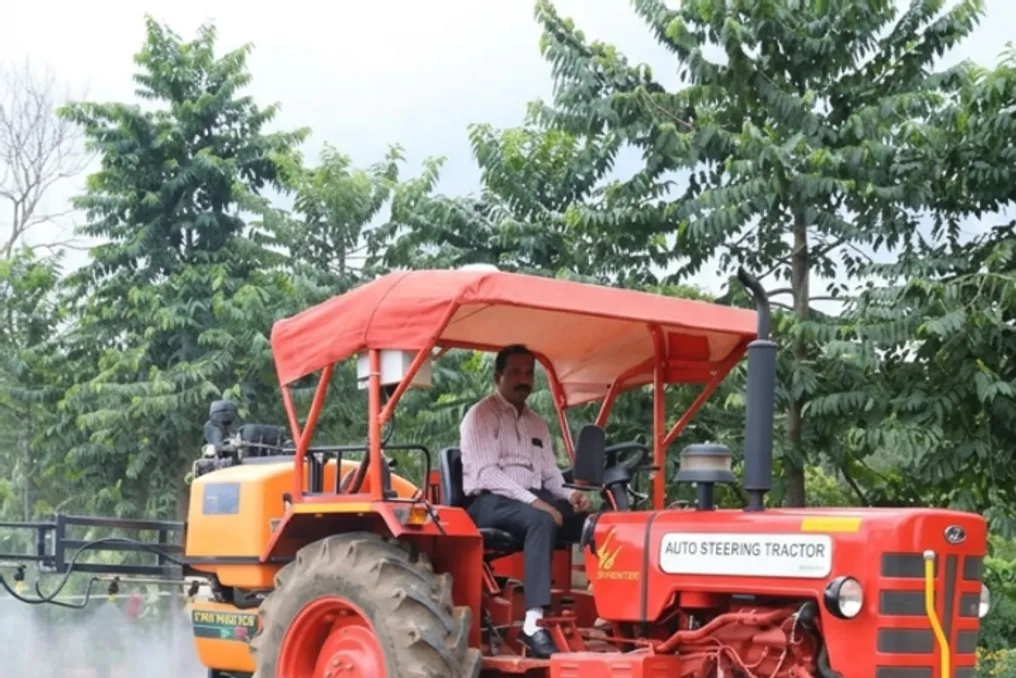
Gurmeet Singh Bhupal from Hanumangarh, Rajasthan, received education only up to the third grade before joining the family farm. His interest in making mechanisms eventually led him to create machinery for farmers. For farmers growing cotton, spraying pesticides required workers to walk alongside tractors and operate the spraying equipment. Bhupal designed an automatic tractor-powered sprayer to eliminate this tedious and dangerous manual labor. His machine uses hydraulic manipulators and semi-rotating spray heads for automatic field coverage. With a working width of 23 meters, it can process up to 5 hectares per hour, consuming about 2 liters of fuel.
Namdeo Radhakrushna Anerao
In the drought-prone region of Pimpalner, small farmer Namdeo Radhakrushna Anerao faced high labor costs and the expense of maintaining oxen. Therefore, he decided to create his own solution. Using scrap metal and locally available parts, Anerao spent three years developing a compact three-wheeled farm machine. The cost of his first prototype was only 35,000 rupees. This machine can be adapted for sowing, fertilizing, plowing, or weeding. Commercial versions cost approximately between 56,000 and 65,000 rupees, offering small farmers an alternative to expensive tractors and oxen.