The average lineup for Proteas is packed with worthy contenders, creating difficulties in selecting the squad. Instead of facing shortages of players, the team might encounter an abundance of talent, as only three players are required for this position in the upcoming ICC 2027 World Cup, which will be held on home soil.
Australian Tour to South Africa
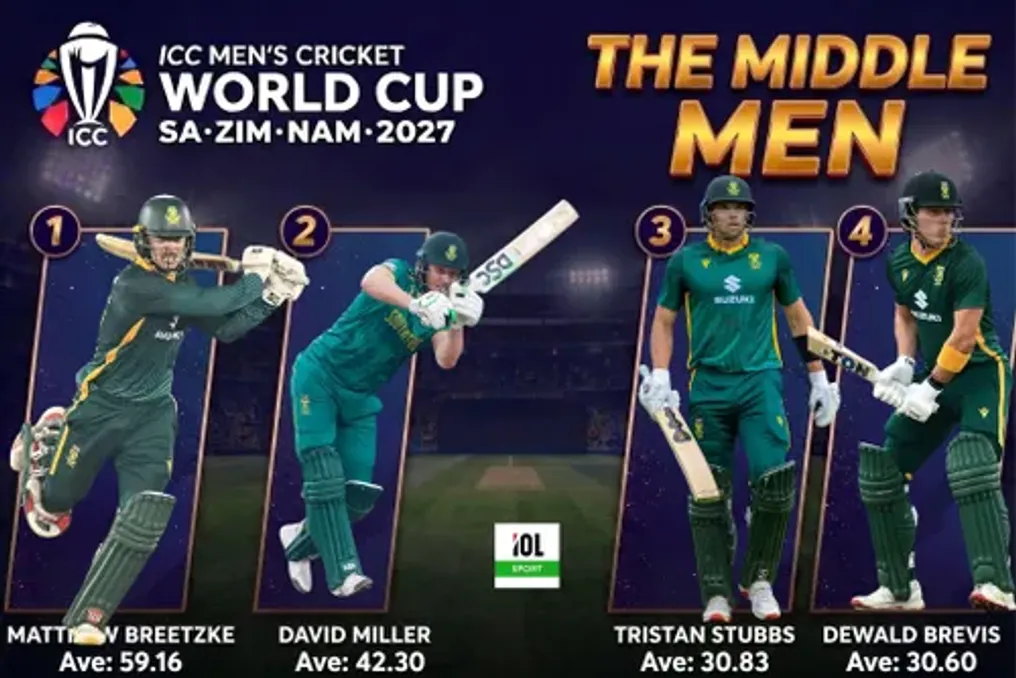
Although 14 ODIs is a small amount of data, Matthew Britzcke is at the beginning of the queue following an impressive start to his ODI career. This player, positioned right of Warriors, became the first in ODI history to score 150 runs in his debut match, and later achieved a world record by scoring fifty-plus in four consecutive matches since the start of his career. Among these achievements is 88 runs off 78 balls against Australia in Mackay last August, which helped secure a series win on Australian soil. His current average stands at 59.16.
Britzcke has scored five out of six half-centuries at number 4, and this is where Proteas coach Shokri Conrad wants him during the series against Australia. The twenty-seven-year-old player is capable of regaining stability after several quick dismissals and accelerating the pace if the game starts well.
Next to him sits David Miller, the most experienced player in this discussion and currently the most controversial. Miller has an average of 43.20 in this format—the figures of a seasoned international finisher, yet he arrives at the series without a central contract. Conrad still selected him, which says a lot: in the eyes of the coaching staff, Miller remains a veteran who maintains composure when the chase becomes tense, and experience is most valuable here.
Nevertheless, Miller will turn 38 just 14 months before the tournament in South Africa, and this is the only reason his continued selection is still debated, as there are many younger candidates vying for a spot.
Following him is Tristan Stubbs, whose ODI average is 30.15, appearing the most vulnerable among the three active names. However, he has two fifties in the last five ODI matches, and along with Miller, he is responsible for finishing games under pressure. Stubbs possesses few equals in controlling the chase amidst chaos, but in the series against Australia, he will face intense scrutiny.
No discussion of this middle order can ignore Dewald Brevis. His absence in the ODI series against Australia caused more debate than most players actually in the squad. Conrad gave a clear and unambiguous explanation: Brevis is competing for a spot with Britzcke, Stubbs, and Miller, and based on current form and capabilities, he ranks fourth in this queue.
Brevis's trial will begin against Bangladesh, and this is a long enough period to ask a talented 23-year-old player to wait while the established players accumulate more starts and receive more thorough preparation for the World Cup.
Beyond the big names, the depth of the Proteas squad has quietly improved compared to previous years, which only lengthens the queue in the middle order rather than shortening it. Connor Esterhuizen continues to build his potential after every played series, boasting an average of 98.50, including a century, in his first three ODI matches in Zimbabwe recently. However, all these runs were scored in the upper order, where there is already a major issue with spots.
Rubin Hermann found himself in a similar situation after impressive performances in two matches for Proteas, but he may have to wait for a injury crisis to be considered.
This is the real story of the Proteas middle order ahead of the home World Cup: they are not lacking in talent. For the first time in a long time, they might have too much.