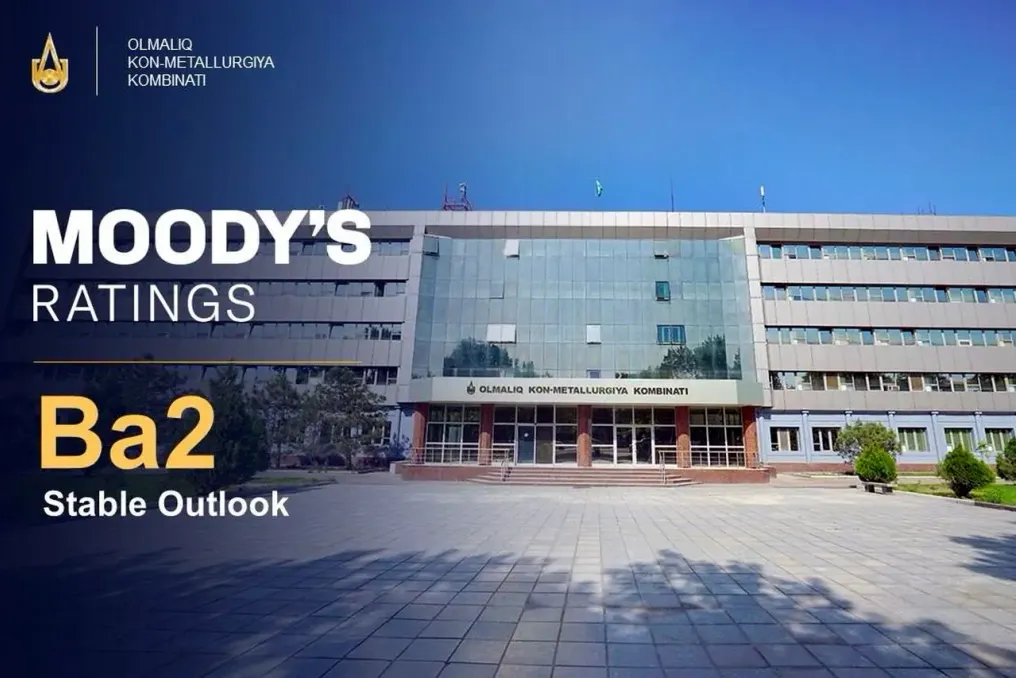
Moody’s Ratings has assigned the Almalyk Mining and Metallurgical Complex (AGMK) its first long-term corporate family rating of Ba2. Additionally, the agency established a Ba2-PD probability of default rating and a ba3 base credit assessment for the company. The rating outlook remains stable.
In assessing AGMK, Moody’s utilized its methodology for state-affiliated issuers, as the Government of Uzbekistan owns 98.7% of the company's shares. The Ba2 rating reflects AGMK's standalone creditworthiness, Uzbekistan's sovereign rating of Ba2, the company's high dependence on the state in case of default, and the high likelihood of receiving extraordinary state support if financial difficulties arise.
Significance of the Company to the Economy
A key factor in this assessment was AGMK's strategic importance to the country's economy. In 2025, the company accounted for 5% of Uzbekistan's GDP and 5.8% of the state budget revenue. AGMK was responsible for 100% of copper production, 90% of silver production, and 20% of gold production in the country.
Moody’s also noted AGMK's vertical integration, which covers ore extraction and processing, smelting, refining, and chemical production. Operational diversification is expected to increase after the launch of the Yoshlik-I mine. According to AGMK forecasts, after reaching full capacity in 2029, the total copper output will approximately double, and gold production will increase by approximately 70%.
The company possesses significant reserves and a long operational lifespan for its main assets. For the Kalmakir mine, this period is 90 years, and for the Yoshlik-I project, it is 48 years. This assessment is based on the national reserve classification and mineral resource evaluation from February 2023 according to the JORC standard.
Financial Performance and Risks
Moody’s assessed AGMK's credit metrics as of the end of 2025 to be sound. The agency-adjusted total debt to EBITDA ratio was 1.8x, while the EBITDA minus capital expenditures to interest expense ratio reached 5.1x. Nevertheless, Moody’s anticipates a moderate deterioration in these indicators due to the implementation of the company's large-scale investment program.
Among the factors limiting the credit rating, the agency highlighted the concentration of operations in the Almalyk district of Tashkent region. In 2025, about 80% of copper and gold production came from the Kalmakir mine. The company's performance is also sensitive to fluctuations in metal prices and the exchange rate of the US dollar against the Uzbek sum. Significant capital expenditures will require attracting additional debt and create execution risks for the Yoshlik-I project expansion.
Dividend payments also put pressure on liquidity. However, the government has adjusted dividend requirements considering investment and debt servicing needs, and AGMK is developing a new dividend policy that will link payouts to debt burden. This policy is expected to be approved by 2027.
Moody’s also noted the company's development of new policies regarding dividends, debt management, and liquidity. The agency believes these measures will strengthen financial discipline. AGMK itself has set a target net debt to EBITDA ratio of 2.5x for the investment cycle up to 2030.
State Support and ESG
The high likelihood of extraordinary state support accounts for preferential financing from state structures. Specifically, the Reconstruction and Development Fund provided AGMK with loans totaling 459 million US dollars at interest rates of 2.25–5% and repayment terms ranging from five to 15 years. Support also includes state guarantees on part of the debt and capitalization of strategic projects. In 2024, about 12 trillion sums of company debt were converted into equity.
Moody’s also considers agreements for the supply of domestic products as an additional supporting factor. In 2025, the Central Bank of Uzbekistan's Precious Metals Agency purchased 94% of AGMK's gold and 100% of its silver at prices linked to London Bullion Market Association (LBMA) benchmarks.
Regarding ESG, Moody’s assigned AGMK an ESG impact score of CIS-2, indicating a minor influence of ESG factors on the rating. The company's corporate governance was rated G-3, reflecting the expectation of balanced financial policy and a prudent approach to liquidity management.
The stable outlook reflects Moody’s view that AGMK's operational and financial performance, credit metrics, and liquidity will not deteriorate significantly. The outlook also includes the expectation of maintaining a high probability of state support for the company. An upgrade of AGMK's rating is possible if Uzbekistan's sovereign rating increases, provided there is no significant deterioration in the company's performance and the probability of state support does not decrease. The base credit assessment may be improved if AGMK significantly increases operational diversification and liquidity, adopts a more conservative liquidity management policy, and sustainably maintains the total debt to EBITDA ratio below 2.0x and the EBITDA minus capital expenditures to interest expense ratio above 4.5x. A downgrade may occur if Uzbekistan's sovereign rating decreases or if AGMK's operational and financial performance deteriorates significantly. Moody’s may lower the base credit assessment if the total debt to EBITDA ratio remains above 3.0x and the EBITDA minus capital expenditures to interest expense ratio remains below 2.5x.