Modern cities rely on established systems around them. However, when planning extends to aquatic environments or off-Earth, these pre-existing systems become inaccessible. In the absence of solid ground or nearby networks for energy, sanitation, transport, and waste management, architecture must assume responsibilities that would normally be provided by broader urban infrastructure.
The reason for developing projects outside known limits varies by case. In the Maldives, building over water is a direct response to the fragility of the existing territory. In Busan, floating development offers a new path for urban expansion. On the Moon, the challenge is extreme, as there is no prior infrastructure for connection.
In these circumstances, infrastructure becomes an integral part of the architectural challenge itself. How people move, how resources are distributed, and how a settlement sustains itself must be planned in conjunction with the spaces designated for habitation.
Building without firm ground
In the Maldives, building over water is intrinsically linked to the vulnerability of the territory itself. A large part of the country is less than one meter above sea level, making future development increasingly dependent on solutions to raise water levels and combat the lack of solid land.
The Maldives Floating City, developed by the firm Waterstudio.NL, is located in a lagoon near Malé and maintains its connection to the capital. Although this positioning allows the venture to fit into an existing urban and economic scenario, it requires that much of its basic systems be reformulated due to the presence of water.
The project is organized around canals, which function as logistics and transport networks, replacing terrestrial streets. Most movement is done on foot, by bicycle, or by boat. Housing blends with hotels, restaurants, commerce, and a marina, following a flexible mesh that adapts to the hydraulic dynamics, rather than imposing a rigid road design.
The floating units are manufactured locally and connected to submerged concrete hulls, which are anchored by telescopic steel piles. Below the structures, artificial coral banks promote marine life, and the reef helps dampen wave impact, thus integrating infrastructure and environment.
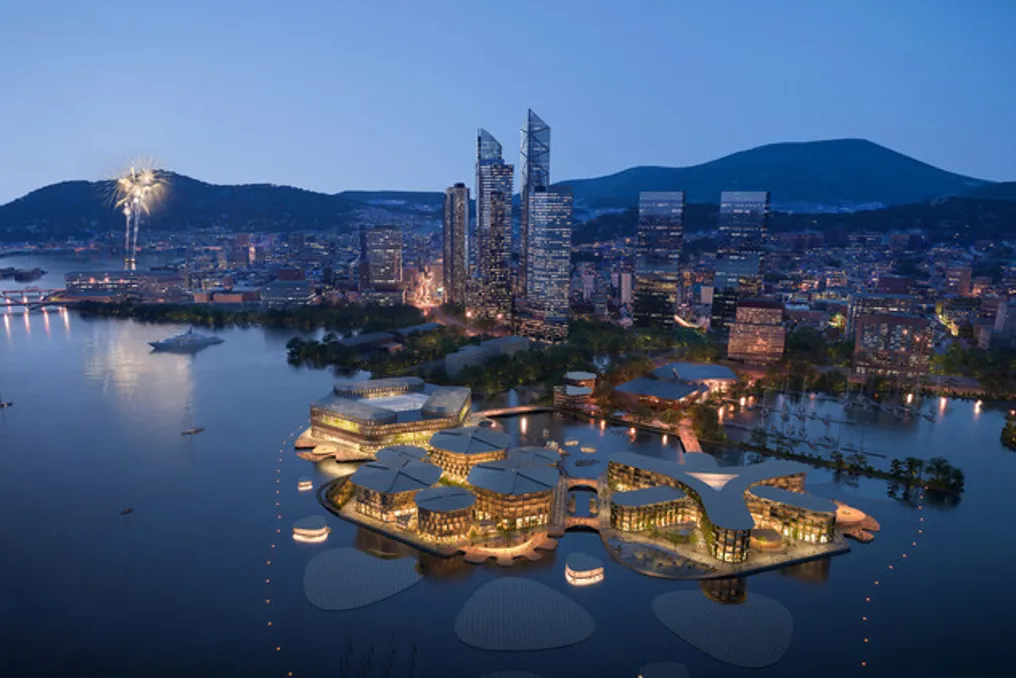
The OCEANIX Busan project adopts a different methodology to address the same problem. Instead of creating an entirely new core, it proposes expanding the city of Busan onto the water. Developed by OCEANIX in collaboration with UN-Habitat and a team including BIG, the floating platforms create additional urban territory without the need for new reclamation.
The initial phase of this undertaking was designed to accommodate approximately 12,000 residents, with potential for growth through new platforms. The platforms are arranged as interconnected neighborhoods: one residential, another focused on maritime research and innovation, and one dedicated to accommodation. Each sector generates its own energy using photovoltaic panels. Water is managed in closed cycles, food is grown locally, and waste systems operate internally. The platforms were designed to function autonomously from the start, without depending on Busan's infrastructure after completion, integrating energy generation, closed-loop water systems, food production, waste management, and mobility from their origin.
In both cases, migration to the aquatic environment does not imply a break from the land city. Malé and Busan remain connected to the larger networks that enable these projects. The crucial distinction lies in the physical nature of the urban expansion: canals take over part of terrestrial mobility, floating structures replace fixed foundations, and marine conditions become part of urban planning, rather than being seen as obstacles to overcome.
When systems become architecture
Building beyond conventional ground modifies a fundamental aspect: it forces systems that are usually treated in isolation to unite into a single design problem. In a typical city, supporting infrastructure is already established. Water arrives via public networks, electricity comes from a wide distribution grid, waste management occurs remotely, and existing roads define the flow of people and goods. Thus, in traditional cities, constructions simply connect to systems already consolidated on a much larger scale.
In the Maldives Floating City, the design team integrated these systems directly into the venture. Electricity is obtained mainly from locally generated solar energy. Sewage is treated on-site and reused as fertilizer for plants. Deep-water cooling replaces conventional air conditioning. Thus, the city operates through a smart grid designed to react to variable demand, climatic conditions, and climate changes.
OCEANIX Busan goes even further. The project incorporates six interconnected systems: circular economy with zero waste, closed water circuits, food production, net-zero energy, innovative mobility, and coastal ecosystem regeneration. The platforms produce 100% of their operational energy locally, using floating and rooftop photovoltaic panels. Hydraulic piping integrated into the hull functions as a large closed-loop heat exchanger with the ocean for climate control (both heating and cooling).
In both projects, energy, water, waste, and mobility define the architectural proposal from the beginning, dictating the implementation of the city, its spatial organization, and the density capacity it can support. Defining these systems must occur early on, as no prior infrastructure is available.
Building without an existing city
The relationship between architecture and infrastructure changes again when there is no nearby city to support the settlement. The Moon Village project, developed by the firm SOM in partnership with the European Space Agency and MIT, investigates permanent housing near the Moon's south pole. Unlike the floating ventures in Malé and Busan, it cannot rely on the extension of an already consolidated city, nor can it count on basic service networks such as water, energy, or transport nearby.
The proposal is structured around residential modules formed by rigid structures and inflatable hulls. Grouped into interconnected sets, they create pressurized environments suitable for living, working, socializing, and moving within the settlement.
The choice of location also determines the operational viability of these spaces. The long periods of solar incidence in the south polar region would allow for photovoltaic energy generation, while nearby ice deposits could provide water and aid in producing breathable air. Therefore, location, infrastructure, and housing begin to operate in close symbiosis.
Resources that would normally be supplied by large urban networks must be sought, produced, stored, or reused alongside the residences themselves. Thus, energy supply, life support, circulation, and access to vital inputs must be planned inseparably and from the first phase.
Even so, permanent housing retains familiar architectural issues. People still need places to sleep, work, socialize, move, and have privacy. Intimacy, common areas, and daily routines remain central to the design, even under drastically different physical conditions.
The Moon Village project takes to the extreme the question raised by floating initiatives. While in Malé and Busan the new settlements maintain ties with existing continental cities, on the Moon, almost all necessary structure to maintain daily life must be implemented autonomously and self-sufficiently on site.
What these settlements demonstrate
The Floating City in the Maldives maintains its connection with Malé; OCEANIX expands Busan onto the water; and Moon Village remodels essential daily life infrastructure for the extreme conditions of the lunar surface. As these projects move away from established urban centers, a greater proportion of the systems that usually sustain urban life must be incorporated directly into the concept of the settlement itself.
Water, energy, mobility, waste, housing, and communal spaces become inseparable design decisions. Systems that in a conventional venture would only be connected after construction must be integrated from the initial phases of the project.
These projects, therefore, illustrate how much architecture depends on infrastructure that transcends the boundaries of the plot. The moment solid ground, public service networks, and immediate resource availability cease to be guaranteed, these systems become architecture themselves.