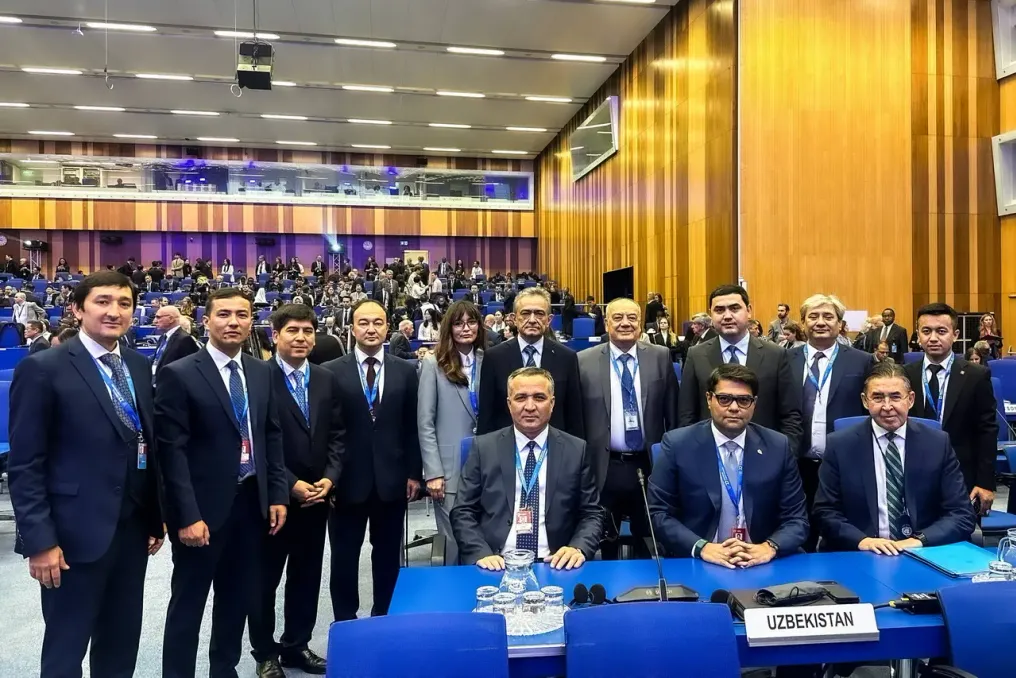
The delegation of Uzbekistan, led by Uzatom Director Azim Ahmedkhadzhayev, participated in the 70th General Conference of the International Atomic Energy Agency (IAEA), which opened in Vienna on September 14. This anniversary session is taking place at the Vienna International Centre and will run until September 18, gathering IAEA member states, international organizations, and representatives of the expert community.
During the general discussion, Azim Ahmedkhadzhayev outlined Uzbekistan's position regarding nuclear non-proliferation, safety, and the development of peaceful nuclear energy. The country reaffirmed its commitment to the Treaty on the Non-Proliferation of Nuclear Weapons and the safeguards agreement with the IAEA. Uzbekistan possesses a state system for accounting and controlling nuclear materials in accordance with the Agency's standards.
The head of the delegation stated: 'The Republic of Uzbekistan consistently reaffirms its firm commitment to the international regime of nuclear non-proliferation.'
Uzbekistan has completed the ratification of several international documents in the field of nuclear safety. These include conventions on early notification of nuclear accidents, nuclear safety, assistance in case of a nuclear or radiological emergency, as well as the Vienna Convention on Civil Liability for Nuclear Damage.
Ahmedkhadzhayev noted that 'a key area in strengthening the national regulatory framework has been the completion of ratification procedures for key international legal instruments.'
In 2026, Uzbekistan began the practical implementation of the project for the region's first nuclear power plant. On June 4, the first concrete was poured in the Jizzakh region under the patronage of President Shavkat Mirziyoyev and with the participation of IAEA Director General Rafael Grossi. The project involves an integrated configuration combining two high-power III+ energy blocks and two low-power units.
The head of Uzatom emphasized: 'For Uzbekistan, this year has been a landmark stage in the development of our national nuclear energy program. We have moved to the practical implementation of the project for the region's first nuclear power plant, including a unique integrated configuration without global precedent.'
An IAEA inspection mission worked in Uzbekistan from June 22 to June 26. Following its work, the Agency noted the country's successes in the field of nuclear energy development, legislative improvement, and fulfillment of recommendations made in 2021.
Ahmedkhadzhayev reported: 'The IAEA's findings confirmed Uzbekistan's significant progress in developing nuclear energy, modernizing legislation, and fulfilling the 2021 recommendations through close partnership.'
Under agreements between President Shavkat Mirziyoyev and IAEA Director General Rafael Grossi, a joint roadmap, the country's framework program, and a comprehensive work plan are being implemented.
The head of the delegation commented: 'In fulfillment of the agreements reached between the President of the Republic of Uzbekistan, Shavkat Mirziyoyev, and IAEA Director General Rafael Mariano Grossi, the joint roadmap, the country's framework program, and the comprehensive work plan are being successfully implemented.'
Uzbekistan is also developing the peaceful use of nuclear energy beyond electricity generation. The country participates in IAEA initiatives such as ZODIAC and Atoms4Food, including the application of nuclear technologies in agriculture and working with drought-resistant crops.
Another area of cooperation is cancer treatment under the 'Rays of Hope' initiative. Since 1994, the Ministry of Health has received technical assistance from the IAEA, including diagnostic and treatment equipment, as well as support in developing dosimetry and laboratory infrastructure. A total of 273 specialists have undergone training at the educational center operating according to ISO standards. By 2030, it is planned to modernize 15 regional oncology centers and continue developing nuclear medicine.
Ahmedkhadzhayev highly praised the Agency's humanitarian mission, the 'Rays of Hope' program, stating: 'We highly value the Agency's humanitarian mission, the 'Rays of Hope' program. We believe that these projects will improve access to modern cancer treatment across the country.'
Uzbekistan's immediate priorities include completing the feasibility study for the NPP, continuing the construction of the integrated facility, concluding contracts for nuclear fuel supply, and ensuring physical protection of facilities. Furthermore, the country intends to strengthen personnel training and production localization.
The head of Uzatom reported: 'By the end of this year, we plan to continue the construction of the integrated nuclear power plant, conclude fuel supply and physical protection contracts, and strengthen personnel training and localization.'
According to Ahmedkhadzhayev, Uzbekistan views the peaceful use of nuclear energy as a tool for developing the energy sector, enhancing energy security, and promoting sustainable development. He concluded: 'Peaceful nuclear energy must serve progress, energy security, and sustainable development. Uzbekistan remains a reliable partner of the IAEA and is ready to expand international and regional cooperation for a stable, clean, and safe future.'